Part III of a Trilogy: Potential Defenses of the Host States

May 22, 2021

We are pleased to introduce the third part of our trilogy of brief commentaries on Investment Treaty Protection & Covid-19 driven State Intervention. In Part I, we saw that states had taken invasive measures in response to the COVID-19 pandemic; some of those could give rise to significant claims, discussed in Part II. The present Part III is devoted to the defenses, which the host states may use to respond to the potential investors’ claims against the measures.

Between May and December 2020, fifty-two countries and the European Union took 96 investment policy measures in response to the COVID-19 pandemic.[i] These may have an impact on foreign investments. The pandemic itself and the subsequent economic crisis may be the factual justification for a state’s particular measure; its legal defences will depend on the character of the measure, its purpose, and the context of such decision-making. Host states may rely on various legal concepts offered as a part of the treaty-based framework (public interest and emergency clauses) or customary international law (necessity and force majeure).

    Public health and public interest

A number of investment agreements expressly contemplate a host state’s right to regulate within its territory to achieve legitimate policy objectives, including public health and safety.[ii] Tribunals also tend to highlight the broad discretion of a state to regulate in the interests of protecting public health as a legitimate public interest and “an essential manifestation of the State’s police power“.[iii] Tribunals are likely to test whether a particular measure meets the criteria of proportionality, non-discrimination and is generally bone fide.

In practice, a plea of public health was successful in cases of Uruguay’s introduction of the tobacco plain packaging requirements,[iv] Canada’s ban of the use of the chemical lindane as a pesticide due to its adverse effect on health and the environment,[v] and the US’ ban of the investor-manufactured drugs in its market due to concerns regarding their quality.[vi]

As a result, arguments advanced by a host state that justify its actions in the interests of public health may be accepted by tribunals if such measures appear proportionate and non-discriminatory. One may argue that such a defence would be more persuasive in circumstances where a state measure related to the treatment of COVID-19, like introducing a compulsory license for drugs for COVID-19;[vii] but less persuasive if it related to the economic consequences of the pandemic (like the provision of state aid only to the host state’s nationals or restrictions on foreign investment). This would also be separate from the issue of compensation for losses, even in the event that the loss was caused by a legitimate measure.

    National emergency clauses / protection of essential security interest

Approximately 10% of the investment agreements contain so-called “emergency clauses” to the effect that the non-performance of obligations by the host state may be excused in the event of a national emergency.[viii] Such clauses refer to “the maintenance of public order,” “the protection of the host state’s essential security interests,” or allow states to fulfil their obligations for “the maintenance or restoration of international peace or security.”[ix] In practice, it is often accepted that a severe economic crisis may constitute a national emergency in the same way as a military action or war may do.[x]

Tribunals are likely to take into account the proportionality of the measure as compared to the severity of the economic crisis. Accordingly, the applicability of the national emergency or essential security defence will depend on the context of the measure in a particular state, as the COVID-19 economic downturn will affect states differently.[xi] Given the global nature of the pandemic, a tribunal may well compare measures taken in different jurisdictions, as well as consider the overall proportionality and reasonableness of the measures.

    Defences under customary international law

In addition to treaty-based defences, host states may also refer to customary international law, namely, the doctrines of necessity and force majeure. Both are included in the ILC‘s Articles on State Responsibility and provide a justification for the non-performance of an obligation.

While the necessity defence underwent great scrutiny in the investor-state cases following the Argentine financial crisis,[xii] there has been little reliance on force majeure in publicly reported cases. The exceptional nature of the COVID-19 pandemic and the consequent economic downturn may mean that host states would be more willing to rely on this defence. The same underlying events, in theory, may give rise to both the defence of necessity and force majeure, as pleaded alternatively in some pending cases against Libya.

Necessity applies where the act by the host state: (i) is the only way for the state to safeguard an essential interest against a grave and imminent peril; and (ii) does not seriously impair an essential interest of the state or states towards which the obligation exists, or of the international community as a whole.

A state may not be the sole judge of the necessity: the tribunal in Pezold v Zimbabwe found that a domestic declaration of a state of emergency could only serve as evidence of a state of emergency that may give rise to a necessity defence under international law.[xiii] In any case, a successful necessity defence does not necessarily prevent the state from having to pay compensation for damages that resulted from the measure during the period of necessity.

The acts covered by the doctrine of necessity must be of an exceptional nature in order for this defence to be successful. Although it has been invoked numerous times by respondent states, arbitral tribunals have rarely upheld it. Namely, the tribunals upheld the plea of necessity in LG&E v. Argentina, Continental Casualty v. Argentina, Total v. Argentina, and Urbaser v. Argentina[xiv] due to the Argentinean economic crisis. However, the same factual circumstances were not accepted in the context of a necessity defence in a number of other cases against Argentina.[xv] Given that the plea of necessity has been invoked to protect a wide variety of interests, including ensuring the safety of a civilian population, states may well rely on the necessity defence in the context of the COVID-19 pandemic.

Force majeure is a doctrine under which a state may be excused from liability where there is the occurrence of an irresistible force or of an unforeseen event, beyond the control of the State, makes it materially impossible in the circumstances to perform the obligation.

Force majeure does not include circumstances in which performance of an obligation has simply become more complicated, for example, due to some political or economic crisis.[xvi] Accordingly, it may be challenging to establish the absolute and material impossibility of performance. Whilst the state’s actions and the underlying context may vary, the regulatory measure of the state may presuppose that a state had a range of options to respond to the peril, which virtually excludes the possibility of referring to the involuntary or coerced conduct. Impossibility is, therefore, a high threshold to reach.

[i] UNCTAD Investment Policy Monitor, Issue No. 24 (UNCTAD website, accessed on 10 April 2021, https://unctad.org/system/files/official-document/diaepcbinf2021d2_en.pdf )

[ii] See, e.g, Comprehensive Economic and Trade Agreement between Canada and the European Union (Article 8.9); United States-Mexico-Canada Agreement (Article 14.10(c)); Canada 2014 Model Investment Protection Agreement; US 2012 Model BIT (Article 8(3)(c)); 2012 Bangladesh – Turkey BIT (Article 4).

[iii] Philip Morris Brand Sàrl (Switzerland), Philip Morris Products S.A. (Switzerland) and Abal Hermanos S.A. (Uruguay) v. Oriental Republic of Uruguay, ICSID Case No. ARB/10/7, Award, 8 July 2016, para. 291

[iv] Philip Morris Brand Sàrl (Switzerland), Philip Morris Products S.A. (Switzerland) and Abal Hermanos S.A. (Uruguay) v. Oriental Republic of Uruguay, ICSID Case No. ARB/10/7.

[v] Crompton (Chemtura) Corp. v. Government of Canada, PCA Case No. 2008-01.

[vi] Apotex Holdings Inc. and Apotex Inc. v. United States of America, ICSID Case No. ARB(AF)/12/1.

[vii]  Vsevolod Tyupa and Alexey Shadrin, Russian government issues first compulsory pharmaceutical licence, (Lexology website, 11 January 2-21, accessed on 10 April 2021, https://www.lexology.com/library/detail.aspx?g=ee05c5b9-3973-4012-90ca-2bb6dff5b417)

[viii] Canada 2014 Model Investment Protection Agreement (Article 18(4)(b)); US 2012 Model BIT (Article 18), number of Singapore BITs.

[ix] 2001 Qatar-Turkey BIT (Article 7), 2003 Denmark – Morocco BIT (Article 2), US 2012 Model BIT (Article 18), 2019 Belarus-Hungary BIT (Article 16).

[x] LG&E Energy Corp., LG&E Capital Corp. and LG&E International Inc. v. Argentine Republic, ICSID Case No. ARB/02/1, Decision on Liability, 3 October 2006, para. 238; Mobil Exploration and Development Inc. Suc. Argentina and Mobil Argentina S.A. v. Argentine Republic, ICSID Case No. ARB/04/16, Separate Opinion of Antonio Remiro Brotóns, para. 43.

[xi] National Grid PLC v. The Argentine Republic, Award, 3 November 2008, para. 180; Total S.A. v. Argentine Republic, ICSID Case No. ARB/04/1, Decision on Liability, 27 December 2010, para. 164.

[xii] See: LG&E v. Argentina, Continental Casualty v. Argentina,  Total v. Argentina, Urbaser v. Argentina, CMS Gas Transmission v. Argentina, Enron v. Argentina, Sempra v. Argentina, El Paso v Argentina, Suez v Argentina, SAUR v Argentina.

[xiii] Bernhard von Pezold and others v. Republic of Zimbabwe, ICSID Case No. ARB/10/15, Award, 28 July 2015, 624

[xiv] LG&E v. Argentina, Continental Casualty v. Argentina, Total v. Argentina and Urbaser v. Argentina

[xv] CMS Gas Transmission v. Argentina, Enron v. Argentina, Sempra v. Argentina, El Paso v Argentina, Suez v Argentina, SAUR v Argentina.

[xvi] Sempra v Argentina, ICSID Case No. ARB/02/16, paragraph 246; Greentech v Italian Republic, SCC Case No. V 2015/095, paragraph 451.

Jo Delaney, Katia Finkel and Katia Contos

globalarbitrationnews.com

Part II of a Trilogy: Investor Claims in Response to the State’s Protective Measures during the Covid-19 Pandemic

May 12, 2021

We are pleased to introduce the second part of our trilogy of brief commentaries on Investment Treaty Protection & Covid-19 driven State Intervention. In Part I, we saw that states have taken invasive measures in response to the Covid-19 pandemic; some of these give rise to significant claims.

While investment treaties are individually negotiated and drafted, they typically include a number of key protections for investors. Provided that foreign individuals or companies meet the definition of “investor” under the instrument and have made a qualifying “investment” (both of which tend to be broadly defined), they can seek to rely on these protections to bring claims against the relevant State possibly side-stepping the national court system.

Critically, they may claim for all of the losses they have suffered from the state. Some reports state that the average amount claimed in an investment treaty claim is USD 1.2 billion, with an average where the claimant succeeds of USD 486 million awarded. As will be clear from the examples below, however, the amount in dispute varies greatly.

This is because investment treaty protections typically include:

  1. Protection from unlawful expropriation without compensation: when there is a substantial deprivation of the investment as a result of actions of the host state, which can be through the nationalisation of an industry, taking physical possession of an asset or through “indirect” or “creeping” expropriation, where a series of actions over time have the effect of depriving an investor of the value of their investment. An expropriation will be unlawful if it was discriminatory, disproportionate or without adequate compensation.

Case on point: many States will have taken a series of measures as a result of COVID-19 that have substantially impacted the profitability and commercial viability of the investor’s business. In 2020, Spain nationalised its hospitals and healthcare providers to help fight against COVID-19. Tribunals have found government restrictions or interference to have constituted an unlawful expropriation and awarded damages for the loss of the investment. ConocoPhillips Petrozuata B.V., ConocoPhillips Hamaca B.V., ConocoPhillips Gulf of Paria B.V. and ConocoPhillips Company v. The Bolivarian Republic of Venezuela[i] is an example of a successful claim for expropriation where Venezuela was found to have expropriated ConocoPhillips’ investments in three oil projects in nationalising the projects without compensation. The investor was awarded over USD 8.7 billion in damages.

  1. Fair and equitable treatment: considered to be the broadest protection, it often includes an obligation for the state to provide a stable and predictable legal and regulatory framework, for the state to act consistently and transparently, that it must not act arbitrarily, nor contrary to the legitimate expectations of the investor and it must provide due process.[ii]

Case on point: in the COVID-19 context, such a claim may arise when, for example, a host state’s interference with a foreign investment was not proportionate to the public interest objective being pursued. Peru’s emergency law suspending the collection of tolls on roads under concession to facilitate the transport of essential goods has been alleged to have been an arbitrary and disproportionate measure. In Técnicas Medioambientales Tecmed, S.A. v Mexico,[iii] Mexico was found to have violated the fair and equitable treatment standard in its contradictory actions in relation to the renewal of a license to operate a landfill, having frustrated the investor’s legitimate expectation that the license would be provided. Mexico had to pay USD 5.5 million in damages.

  1. Most favoured nation (MFN) treatment and national treatment: foreign investors are to be treated no less favourably than local investors (national treatment) and other foreign investors (MFN treatment), subject only to specific and carefully defined exceptions. Tribunals often look beyond the letter of the law to see whether the practical effect of the state measure is to create a disproportionate benefit for nationals over non-nationals and whether the measure, on its face, appears to favour its nationals over non-nationals who are protected by the relevant treaty.[iv]

Case on point: this protection may be particularly relevant to investors seeking compensation for COVID-19 bailout measures that favour domestic investors. In Germany, a 750 billion euro package was introduced in March 2020 to mitigate the damage of COVID-19, including a stabilisation fund to protect domestic firms from foreign takeover by taking direct equity in German companies.[v] Germany’s Economy Minister Peter Altmaier warned foreign investors as follows: “I say to all those people in hedge funds and elsewhere who are looking forward to acquiring one or the other [German firms] on the cheap — make no mistake, we are determined to stand by our companies.”[vi] Germany subsequently bought a stake in vaccine developer CureVac AG for EUR 300 m after speculation that the US was looking to buy the company.[vii]

Other governments have made similar public statements expressing their protection of local investors, suggesting that we may increasingly see a move to local investors being treated more favourably than foreign investors – for example:

  • On 18 April 2020 the Canadian Government published its Policy Statement on Foreign Investment Review and COVID-19 that announced an “enhanced scrutiny” under the Investment Canada Act of “foreign direct investments of any value, controlling or non-controlling, in Canadian businesses that are related to public health or involved in the supply of critical goods and services to Canadians or to the Government”.[viii]
  • Ursula von der Leyen, President of the European Commission addressed all EU member states in March 2020 with the following call to action: “You should use all options to protect critical European companies from foreign takeovers or influence that could undermine our security and public order”.[ix]
  1. Umbrella clause: the host state often undertakes to comply with all the obligations it owes to the investor, which has been previously held to include obligations contained in contracts between the state and the investor.

Case on point: this will be particularly relevant where an investor has an agreement or contract with the state or a state agency that has been breached, for example, where the host state took COVID-19 related measures in breach of public sector procurement contracts giving rise to potential investment treaty claims.

  1. International arbitration: as famously stated before “there is no right without a remedy”. What differentiates investment treaty protection from other international legal safeguards is that it usually offers the foreign investor, be it an individual or a company, the ability to bring proceedings against the host state directly. There may be jurisdictional or admissibility pre-conditions, but this ability to commence proceedings against the state in a neutral setting under international law (and scrutiny) with an enforceable decision is the real guardian of foreign investments.

For any foreign investor who has suffered as a result of state measures, there are two key takeaways:

First, foreign investors affected by state measures as a result of COVID-19 should consider whether they have treaty protections and can seek compensation for the loss suffered.[x]

Second, prospective foreign investors must ensure that they structure their foreign investments so as to benefit from investment treaty protection; not to do so would be imprudent.[xi]

Next time, we will change perspective and tell you how what legitimate armoury governments have in the face of a claim by foreign investors.

[i] ICSID Case No. ARB/07/30.

[ii] See for example, Técnicas Medioambientales Tecmed, S.A. v. The United Mexican States (ICSID Case No. ARB (AF)/00/2), in which the tribunal stated that “[t]he foreign investor expects the host State to act in a consistent manner, free from ambiguity and totally transparently in its relations with the foreign investor, so that it may know beforehand any and all rules and regulations that will govern its investments, as well as the goals of the relevant policies and administrative practices or directives, to be able to plan its investment and comply with such regulations” (para 154, Award, 29 May 2003). See also Ioan Micula, Viorel Micula, S.C. European Food S.A, S.C. Starmill S.R.L. and S.C. Multipack S.R.L. v. Romania (ICSID Case No. ARB/05/20) where the tribunal sated that “the state may always change its legislation, being aware and thus taking into consideration that: (i) an investor’s legitimate expectations must be protected; (ii) the state’s conduct must be substantively proper (e.g., not arbitrary or discriminatory); and (iii) the state’s conduct must be procedurally proper (e.g., in compliance with due process and fair administration)” (Award, 11 December 2003, para 529).

[iii] ICSID Case No. ARB (AF)/00/2.

[iv] D. Myers, Inc. v. Government of Canada (UNCITRAL), Partial Award, 13 November 2000, para 252.

[v] Michael Nienaber, “Germany launches 750 billion euro package to fight coronavirus”, Thomson Reuters (23 March 2020, accessed 24 March 2021, https://www.reuters.com/article/us-health-coronavirus-germany-budget-idUSKBN21A2XU).

[vi] Guy Chazan and Jim Brunsden,”Coronavirus crisis pushes Europe into nationalist economic turn”, FT (26 March 2020, accessed 24 March 2021, https://www.ft.com/content/79c0ae80-6df1-11ea-89df-41bea055720b).

[vii] Naomi Kresge, Germany Moves to Secure Stake in Virus Vaccine Developer, Bloomberg (15 June 2020, accessed 24 March 2021, https://www.bloomberg.com/news/articles/2020-06-15/germany-to-buy-23-stake-in-virus-vaccine-developer-curevac).

[viii] “Policy Statement on Foreign Investment Review and COVID-19” ( Government of Canada website, 18 April 2020, accessed 24 March 2021, https://www.ic.gc.ca/eic/site/ica-lic.nsf/eng/lk81224.html).

[ix] Guy Chazan and Jim Brunsden,”Coronavirus crisis pushes Europe into nationalist economic turn”, FT (26 March 2020, accessed 24 March 2021, https://www.ft.com/content/79c0ae80-6df1-11ea-89df-41bea055720b).

[x] See our COVID-19 Government Intervention Schemes guide at: https://www.bakermckenzie.com/-/media/files/insight/publications/2021/03/gis_guide_5_-march_2021.pdf

[xi] See our Empirical Study: Corporate Restructuring and Investment Treaty Protection at: https://www.biicl.org/projects/empirical-study-corporate-restructuring-and-investment-treaty-protections

Jo Delaney, Katia Finkel and Katia Contos

globalarbitrationnews.com

 

Part I of a Trilogy: State Measures in Response to the COVID-19 Pandemic

May 5, 2021

States around the world have adopted measures in reaction to the unprecedented nature and scale of the COVID-19 pandemic to curb the spread of coronavirus, ensure healthcare systems are not overrun and, more recently, balance reviving the economy and keeping control of the virus. These wide-ranging and far-reaching measures are not without consequences, particularly on foreign investments.

We highlight examples of measures that may have the potential — and for some have already started — to give rise to claims under investment treaties.

Suspension of activities

Many states have temporarily suspended the activities they deemed nonessential. Ukraine suspended all nonessential commerce.  Italy shut down all businesses, save ‘strategic’ ones.  South Africa closed bars, nightclubs and prohibited sale of alcohol.  Others have taken measures to change the normal course of some activities. France postponed payment of water, gas or electricity bills and rents for small firms.  Singapore suspended contractual obligations under a range of ‘scheduled contracts’.  Russia adopted a law entitling the government to set maximum prices for drugs and medical devices.  In South America, Peru adopted an emergency law suspending the collection of tolls on roads under concession to facilitate the transport of essential goods; which a road concessionaire has already branded as an “unconstitutional measure.”  Two French airport operators threatened proceedings against Chile as a result of the closure of flight routes and additional sanitary measures in Santiago’s international airport.

Restrictions on foreign investments in strategic areas

The pandemic has also caused several states to restrict foreign investments. In France, a decree added “biotechnologies” (possibly including research for COVID-19 vaccine) to the list of critical technologies where a foreign investment needs a prior government authorization.  The US Committee on Foreign Investment was also given greater powers to limit foreign investments in the health and pharmaceutical sectors, as well as those that may threaten supply security.  The UK is introducing the National Security and Investment Bill to expand the government’s existing powers to review transactions concerning foreign control of national businesses in “sensitive” sectors.

Nationalization of businesses or compelling them to manufacture specific goods

To tackle the pandemic, some states have nationalized businesses. Spain, for example, nationalized all of its private hospitals and healthcare providers overnight, and their facilities were requisitioned for patients specifically suffering from COVID-19.  The US government used its power under the Defense Production Act  to compel companies (General Motors, General Electric, Medtronic and 3M among others) to manufacture medical items that were in short supply, such as personal protective equipment, ventilators and hospital beds.

Broader government intervention during state of chaos

The chaos and disruption of the pandemic has sometimes been used as an opportunity to introduce drastic measures. Mexico adopted two energy policies that were said to be in response to the fall in energy demand caused by COVID-19.  The policies have had the practical effect of curbing renewable energy production by suspending all testing on solar and wind farms, giving enhanced grid access to non-renewable electricity generators, and strengthening the Federal Electricity Commission’s role in electricity planning. In response, several investors are reportedly considering bringing a claim against Mexico amid a doubt over the motive of these measures.  Similarly, an investor brought an SCC arbitration against Moldova, accusing the state of using the pandemic to cancel its concessions to operate the country’s main international airport. An SCC emergency tribunal has recently restrained the state from terminating the concession.

Next time we will tell you more about the actions investors can take to enforce their rights.

Jo Delaney, Katia Finkel and Katia Contos

globalarbitrationnews.com

Non-Payment of Advances on Costs in Arbitration

17/04/2021 by International Arbitration


The commencement of international arbitration is conditioned by payment of advances on costs, after the payment of a filing fee. Unlike domestic courts, which are publicly-funded, advances on costs are needed to pay the fees of private arbitrators. If the arbitration is administered, costs also need to be advanced to pay the administrative costs of the arbitration institution.

Under all major institutional arbitration rules, the parties are requested to pay deposits for the arbitration in equal shares. If one party refuses to comply with this payment obligation, however, often the respondent, the other party generally has no choice but to bear the advances on costs alone.

Due to this fact, non-payment of advances on costs is a tactic that is increasingly abused by certain parties in international arbitration, typically respondents, to deter the other party from pursuing their claims, especially when one party is known to be facing financial difficulties.

The tactic’s aim is for the other party to withdraw its claims, due to the increase in the advance on costs the other party will be required to pay. While this tactic often backfires, as arbitral tribunals generally frown upon one party’s non-payment of advances on costs, in direct violation of procedural rules, this has not prevented this tactic from being increasingly used in an attempt to stifle claims.

The present post aims to explore the remedies available when one party defaults on its obligation to pay its share of the advance on costs, under major institutional arbitration rules.

Non-Payment of the Advance on Costs Under the ICC Rules

The arbitration rules of the International Chamber of Commerce in force as from 1 January 2021 (the “ICC Rules”) refer to the advance to cover the costs of the arbitration in Articles 37 and 38.[1]

As under most arbitration rules, Paragraph 2 of Article 37 of the ICC Rules specifies that “the Court shall fix the advance on costs in an amount likely to cover the fees and expenses of the arbitrators” and the “advance on costs fixed by the Court pursuant to this Article 37(2) shall be payable in equal shares by the claimant and the respondent.”

If one party fails to pay its share of the advance on costs, the ICC Rules provide for several remedies.

First, the other party may pay the other party’s share of advances on costs (Article 37(5) of the ICC Rules). It may generally request these payments to be reimbursed in a subsequent award on costs.

Second, after consultation with the arbitral tribunal, the Secretary General may instruct the arbitral tribunal to “suspend its work and set a time limit, which must be not less than 15 days, on the expiry of which the relevant claims shall be considered as withdrawn.” For instance, if it is the respondent that fails to pay its share, any counterclaims would be withdrawn but not its defences to the claimant’s claims. This remedy is limited insofar as the party failing to pay “shall not be prevented, on the ground of such withdrawal, from reintroducing the same claims at a later date in another proceeding” (Article 37(6) of the ICC Rules).

In addition to the remedies specified under the ICC Rules, the Secretariat’s Guide to ICC Arbitration notes the paying party’s ability to request that the arbitral tribunal render a partial award ordering the non-paying party to reimburse it. To justify such relief, the paying party may rely upon the contractual obligation to effect payments that the parties bear under the ICC Rules. While not all ICC arbitral tribunals have considered that they had the power under the ICC Rules to order the failing parties to pay their share of the advance on costs, partial awards for costs paid in place of the non-paying party are fairly common, when requested.[2]

Even in the absence of a partial award on costs, however, pursuant to Article 38(4) of the ICC Rules, “The final award shall fix the costs of the arbitration and decide which of the parties shall bear them or in what proportion they shall be borne by the parties.” Arbitral tribunals will typically take into account the fact that one party refused to pay the advance on costs, when making their decision on costs.

Remedies for Non-Payment of the Advance on Costs under the HKIAC Rules

The Hong Kong International Arbitration Centre (the “HKIAC”) takes a similar approach to the ICC regarding payment and non-payment of the advances on costs in its rules, while explicitly providing that the party paying in the place of the non-paying party may request a separate award for reimbursement of payment.[3] Pursuant to Articles 41.4 and 41.5 of the 2018 HKIAC Procedures for the Administration of International Arbitration:

41.4 If the required deposits are not paid in full to HKIAC within 30 days after receipt of the request, HKIAC shall so inform the parties in order that one or another of them may make the required payment. If such payment is not made, the arbitral tribunal may order the suspension or termination of the arbitration  or continue with the arbitration on such basis and in respect of such claim or counterclaim as the arbitral tribunal considers fit.

41.5 If a party pays the required deposits on behalf of another party, the arbitral tribunal may, at the  request of the paying party, make an award for  reimbursement of the payment.

Non-Payment of Advances on Costs under the ICDR Rules

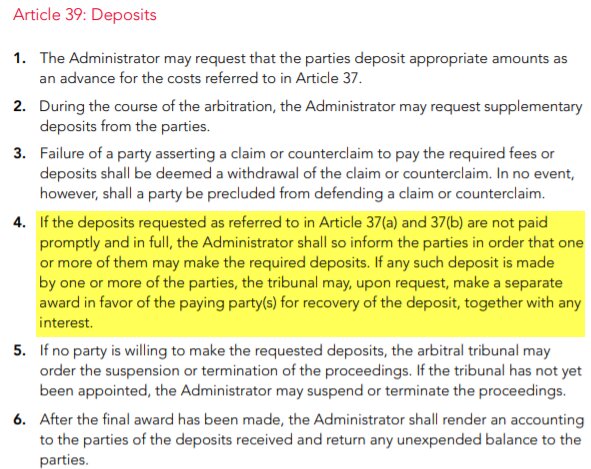
Article 39 of the International Arbitration Rules of the International Centre for Dispute Resolution (the “ICDR Rules”) also explicitly provides for the arbitral tribunal to render a separate award in respect of the non-payment of the advances on costs, while entitling the paying party to interest:

Non-Payment of the Advances on Costs under the LCIA Rules

Contrary to the ICC Rules, under the arbitration rules of the London Court of International Arbitration (the “LCIA Rules”) advances on costs are addressed to the parties from time to time.[4]

With regard to non-payment by a party of advances on costs, it comes as no surprise that the LCIA Rules contain a provision nearly identical to the ones in other institutional rules (Article 24.6 of the LCIA Rules), allowing the other party to pay in the place of the non-paying party:

24.6 In the event that a party fails or refuses to make any payment on account of the Arbitration Costs as directed by the LCIA Court, the LCIA Court may direct the other party or parties to effect a further Advance Payment for Costs in an equivalent amount to allow the arbitration to proceed (subject to any order or award on Arbitration Costs).

However, the paying party is also explicitly entitled to request an order or award in order to recover the amount paid as debt, together with interest, from the defaulting party:

24.7 In such circumstances, the party effecting the further Advance Payment for Costs may request the Arbitral Tribunal to make an order or award in order to recover that amount as a debt immediately due and payable to that party by the defaulting party, together with any interest.

Conclusion on Non-Payment of Advances on Costs

When a party refuses to pay its share of the advances on costs, institutional rules provide for the arbitral tribunal, or the institution itself, to direct the failing party to make a substitute payment, failing which the proceedings may be suspended or claims/counterclaims may be considered withdrawn.

The parties shall, however, bear in mind that not all institutional rules explicitly empower arbitral tribunals to issue a partial award that orders the reimbursement of an advance on costs the other party refuses to pay, although this is becoming increasingly common.

Also, in the short-term, the paying party generally has no choice but to pay for the arbitration on behalf of the non-paying party, whose counterclaims will typically be unable to continue (even if they are reframed as set-off claims, if they require the arbitral tribunal to consider additional matters).

While the non-paying party’s costs that were paid may typically be recovered in the final award, when preparing an arbitration budget, parties should keep in mind that the other party may refuse to pay its share of the advance on costs, in order to seek a tactical advantage.

[1] See Aceris Law – Advance on costs in ICC arbitration

[2] See e.g., Procedural Order No 10 in ICC Case No. 12895.

[3] See Aceris Law – The timing of payment of arbitration advances on costs

[4] See Aceris Law – The timing of payment of arbitration advances on costs


international-arbitration-attorney.com

Insisting on Live, In-person Arbitration Hearings During The Pandemic

Throughout the coronavirus pandemic, parties to an arbitration agreement and arbitrators have grappled with the issue of the right to a live, in-person arbitration hearing.  Is there a due process concern that flows from conducting remote proceedings over one side’s insistence on in-person hearing?  For example, parties’ facility with presenting testimony and evidence remotely may be limited, arbitrators’ technical proficiency may be lacking, and they may be uncomfortable with taking evidence remotely.  Then there is the difficulty of presenting the case effectively across different time zones and the potential unfair advantage to one party over another caused by requiring one party’s witnesses and evidence to be presented outside normal business hours.  In some cases, there may be physical evidence that is difficult to present remotely or the need for a site visit.

While one party may be willing to wait for the COVID-19 crisis to end in order to conduct in-person hearings, the other side might not agree.  Postponing a hearing on the merits may be inconsistent with contractual time limitations, real-world time pressures that affect the parties differently, and/or timing requirements in arbitration rules.  Difficulties may arise when one party insists on in-person hearings in the designated place of arbitration.

In some circumstances, the arbitration rules may contemplate remote hearings.  For example, the London Court of International Arbitration Rules provide that “a hearing may take place in person, or virtually by conference call, videoconference or using other communications technology with participants in one or more geographical places (or in a combined form).” And that the tribunal may use technology “to enhance the efficiency and expeditious conduct of the arbitration.”  Consistent with that directive, at least one English court has recently held that a proposed hybrid hearing in which both in-person and remote proceedings take place would not unfairly advantage one party over the other.

Likewise, while the International Chamber of Commerce Rules of Arbitration provide that the tribunal “shall hear the parties together in person,” the ICC has interpreted this rule “as referring to the opportunity for a live, adversarial exchange and not to preclude a hearing taking place ‘in person’ by virtual means if the circumstances so warrant.”  Indeed, the 2021 ICC Rules, which took effect January 1, 2021, expressly permit tribunals to conduct hearings “remotely by videoconference, telephone or other appropriate means of communication.”

Additionally, the Singapore International Arbitration Centre recently reported that all in-person meetings are now “being conducted by teleconference and videoconference” and has directed all parties to file and exchange papers electronically.  By contrast, the Hong Kong International Arbitration Centre remains operational and will admit parties for in-person hearings and meetings, provided that all parties have remained in Hong Kong continuously for the 14-day period prior to admittance, submit to temperature checks, and otherwise comply with its COVID-19 protocols.

In practice, parties to an arbitration agreement may not be able to force an in-person arbitration hearing during the pandemic.  For example, unless the parties stipulate to proceed telephonically or via Zoom or the panel orders that the hearings will take place telephonically or via Zoom, the Financial Industry Regulatory Authority (FINRA) postponed all in-person arbitration and mediation proceedings scheduled through June 4, 2021.  The FINRA guidance does not specify what happens if one party refuses to stipulate to remote proceedings.

In one well-publicized dispute, a union representing bus drivers in Reno, Nevada commenced an arbitration proceeding against Keolis North America, alleging that Keolis wrongfully threatened to terminate bus drivers who refused to let riders board buses without a face mask.  Keolis insisted on an in-person arbitration hearing that was scheduled for March 5, 2021.  Citing COVID-19 concerns, however, the arbitrator refused to attend the hearing in person and instead offered to attend the hearing via video.  Keolis accused the arbitrator of bias in favor of the union for refusing to attend the hearing in person.  The arbitrator said Keolis’s allegations were baseless but has since withdrawn from the case.

In our experience, attempts to compel non-remote hearings seem unlikely to succeed while public health concerns remain.  Arbitration tribunals have rejected arguments that due process requires in-person hearings or that remote hearings give one side an unfair advantage.  At the same time, arbitration tribunals have taken great pains to protect the principal of equality of arms, often crafting creative case management techniques to address perceived shortcoming of remote hearings.  Our informal survey revealed not a single case in which an international arbitration tribunal has ordered the parties to appear in person during the pandemic.

The remote arbitration hearings are likely to remain the standard for the duration of the pandemic. Arbitrators can and should continue their efforts to ensure that parties and witnesses are not required to participate in remote hearings or present evidence in ways that threaten due process, including such mundane considerations as what time of day a witness must testify or counsel must present arguments.  Arbitrators should also allow sufficient time to elapse between the end of one hearing session and the commencement of another. And they should consider commencing hearings at different times on different days, so each side can present its case at times that are optimal or convenient for its time zone.  If a party wants to ensure an in-person hearing, that party should include mandatory language in the contractual arbitration clause, knowing that such language could make it impossible to enforce time limits on the rendering of an award.

natlawreview.com

П О К А Н А за участие в научна конференция

Sorry, this entry is only available in Български.


СЪВРЕМЕННОТО МЯСТО И РОЛЯ НА АЛТЕРНАТИВНИТЕ СПОСОБИ ЗА РАЗРЕШАВАНЕ НА СПОРОВЕ – МЕЖДУ ТРАДИЦИЯТА И АКТУАЛНАТА ПРАВНА УРЕДБА В БЪЛГАРИЯ И ДЪРЖАВИТЕ-ЧЛЕНКИ НА ЕВРОПЕЙСКИЯ СЪЮЗ

9-10.11.2018 г., Велико Търново


            Имаме удоволствието да ви поканим да вземете участие в научна конференция на тема „Съвременното място и роля на алтернативните способи за разрешаване на спорове – между традицията и актуалната правна уредба в България и държавите-членки на Европейския съюз“, която ще се проведе на 9 и 10 ноември 2018 г. във Великотърновски университет „Св. св. Кирил и Методий“. Конференцията се осъществява с подкрепата на едноименния проект по Наредбата за научно-изследователската дейност на МОН от екип от Юридически, Исторически, Стопански и Философски факултет на Великотърновски университет „Св. св. Кирил и Методий“.


Основната цел на предлаганата конференция е превръщането й в научен форум по проблемите за мястото и ролята на алтернативните способи за разрешаване на спорове и конфликти в правен, исторически, икономически и политически аспект.

Можете да се включите в конференцията с доклад с продължителност до 15 минути. Приоритетно, но не единствено, внимание ще имат предложения, които се отнасят до проблеми като:

  • Актуални тенденции и изследвания върху развитието на алтернативните способи за разрешаване на спорове и конфликти;
  • Сравнително правни изследвания на практиките в държави-членки на ЕС, както и практиките на българските съдилища;
  • Исторически традиции в България в лицето на института на посредничеството, арбитража, както и различните форми на спогодби;
  • Политическата медиация, модели за разрешаване на спорове и конфликти;
  • Психологически аспекти на медиацията, като алтернативен способ за разрешаване на спорове.

Общото познание на темите за посредничество, спогодба, помирение, споразумение, арбитраж надхвърля знанието на отделните правни науки по темата, за това в конференцията могат да се включат изследователи от различни области на науката.

Конференцията е отворена за участие на историци, икономисти, управленци, юристи, социолози, политолози, психолози, педагози, тесни специалисти по темата, работещи в областта на медиацията и алтернативните способи за разрешаване на спорове, експерти др.

            Вашият текст следва да бъде оформен според стандартните технически параметри и да отговаря на следните допълнителни изисквания:

  • Да притежава резюме (Abstract) от 150–300 думи на английски език, поставено веднага след заглавието, което също да бъде преведено и на английски език;
  • След резюмето да бъдат изписани на английски език ключовите думи в текста;
  • Да е посочена JEL класификация. За подробности виж тук
  • Снимките, таблиците, диаграмите и схемите (ако има такива) да се поставят на точното място в текста, да се номерират с последователна номерация и да имат анотиращи текстове;
  • Архивните материали да се цитират в бележки под линия – footnotes;
  • Цитирането на ползваните извори и литература да е съгласно т.нар. Харвардска система (Harvard short reference system). За подробности виж тук
  • При цитирането на литературата да се прилага транслитерация на имената на авторите от кирилица на латиница според Обтекаемата система. За подробности виж тук
  • При цитирането на литературата, заглавията на публикациите на кирилица се превеждат на английски език.
  • Обем на докладите до 15 страници.

Официални езици на конференцията: английски, български, руски.

Заявки за участие, включващи резюме (до 150 думи) се приемат до 20.07.2018 г. на следния имейл адрес: flconference@ts.uni-vt.bg

Желаещите да се включат в конференцията трябва да заплатят такса правоучастие 70 лв./40 евро/, изпратена по банков път:

Банка: ТБ “Алианц България”

BIC: BUINBGSF

IBAN: BG 50 BUIN7001 3152500016

Основание за плащане: Такса правоучастие от името на [име на участника] за конференция на Юридически факултет на ВТУ „Съвременното място и роля на алтернативните способи за разрешаване на спорове – между традицията и актуалната правна уредба в България и държавите-членки на Европейския съюз“.

Командировъчните разходи са за сметка на участниците.

Таксата на всеки участник включва:

  • Конферентни материали;
  • Участие в секциите на конференцията;
  • Кафе паузи;
  • Коктейл;
  • При доклади в съавторство всеки автор заплаща отделна такса.
  • При участие с доклад без присъствие на конференцията се заплаща пълната такса участие.
  • Един печатен екземпляр от сборника с докладите от конференцията.

Медиаторите решават спорове без съд

Sorry, this entry is only available in Български.


Съдебното производство е класическият начин за решаване на професионални и лични спорове, в които страните не съумяват да постигнат равновесие на интересите си. Но често съдебните процеси отнемат много време и средства. Много по-бързо, по-лесно и с много по-малко средства протича процесът на помиряване, ако той се осъществява от самите спорещи. Именно за това в съвременните общества е развит един алтернативен начин за решаване на споровете, а именно медиацията (посредничеството).

Основата

Медиацията е един от способите за извънсъдебно разрешаване на спорове. Тя е реална алтернатива на съдебния процес. В България от 2004 г. този процес е уреден със Закона за медиацията и Наредба № 2 от 15.03.2007 г. на министъра на правосъдието за условията и реда за одобряване на организациите, които подготвят медиатори, изискванията за обучение на медиатори, създаден е ред за вписване, отписване и заличаване на медиатори от Единния регистър на медиаторите и за процедурните и етичните правила на поведението им.

По своята същност медиацията е способ за доброволно разрешаване на спорове, при който страните се подпомагат от трето, неутрално и безпристрастно лице – медиатор, за постигане на споразумение, което удовлетворява взаимно всички страни в спора.

Характерно за процеса на медиация е, че процедурата е доброволна и поверителна, като третото лице – медиаторът, подпомага спорещите страни и ги води към споразумение. Влизането в процеса на медиация става доброволно по волята на страните в спора, като именно неформалността на този извънсъдебен способ дава възможност той да бъде прекратен по всяко време, ако не се стигне до съгласие. В този смисъл медиацията е много по-гъвкава като процедура, за разлика от съдебния процес, а и в крайна сметка постигането на съгласие е чрез компромиси, направени при взаимност. Този начин на решаване на спора е практическа възможност спорещите сами да изгладят проблема. За разлика от съдебния процес обаче, медиацията не може да гарантира решаването на спора.

Посредникът

Основно действащо лице в процеса по медиация е медиаторът. Той е неутрална страна в спора и действа съобразно определени правила на поведение и поема отговорност при преговорите между страните. Медиаторът не проявява пристрастие и не налага решения. По време на преговорите всички обстоятелства, факти и документи, които се използват и станат известни, са поверителни. Участниците в процедурата по медиация са длъжни да пазят в тайна всички дискусии и коментари, довели до решаването на спора.

Приложно поле

Медиацията може да се използва за решаването не само на правни, но и на извънправни спорове. Важното е разногласията да не налагат непременно намеса на държавата за решаването им, а да може да се решат успешно от самите страни.

В Закона за медиацията се определят и видовете спорове, при които тя може да се прилага: граждански, търговски, трудови, семейни, административни, такива, засягащи потребителските права, спорове между физически и/или юридически лица. Прилагането на медиацията в сферата на наказателното право е възможно само в изрично предвидените от Наказателнопроцесуалния кодекс случаи. Когато закон или друг нормативен акт предвижда специален ред за сключване на споразумение, медиацията не се използва.

За разлика от съдебния процес, който завършва с решение, успешно проведената медиация завършва с подписване на споразумение, с което се съгласяват спорещите страни.

Съгласието

Споразумението в медиацията представлява по същество един договор. Затова от неговите последствия може да се възползват само страните, участвали в процеса по медиация за конкретния спор. Споразумението е едно приемливо и за двете страни изявление, което урежда отношенията им след успешното приключване на спора и служи като основа за бъдещите им действия, за които те са постигнали съгласие. Споразумението задължава страните само за това, за което са се договорили. И накрая, за да може то да изпълни своята цел, споразумението трябва да съответства на закона и морала. Споразумение, което противоречи на закона или го заобикаля и/или накърнява добрите нрави, е нищожно и законът го обявява за несъществуващо.

При договарянето страните имат пълна свобода на волята, като законът им дава възможност сами да определят вида на споразумението. Формата може да бъде устна, писмена или писмена с нотариална заверка. Устната форма се използва рядко и само когато се уреждат еднократни действия и страните си имат доверие. Писменото споразумение трябва да съдържа мястото и датата, на която е било постигнато, имената на страните и техните адреси, за какво се съгласяват те, името на медиатора и подписите на страните.

Писмената форма с нотариална заверка е по-сложна форма на споразумение, защото изисква съдействието на нотариус. Тази форма обаче дава по-голяма сигурност за изпълнението му и евентуалната възможност за неговото оспорване. По своята форма споразумението е частен документ, а съгласно действащия Гражданскопроцесуален кодекс всеки може да представи на нотариус частен документ, за да бъде удостоверена датата на неговото представяне и/или подписите, и/или неговото съдържание. Страните имат свобода при избора каква част от споразумението да заверят нотариално. Удостоверяването на датата и подписите се прави чрез бележка в специален регистър за тези удостоверявания, а при удостоверяване на съдържанието се прави препис, който се пази в специална книга.

Медиаторите

Медиацията се осъществява от физически лица. Те могат да имат различна професия и степен на образование, но задължително преминават през специален курс на обучение. От кръга на физическите лица, които могат да изпълняват ролята на медиатори, са извадени съдиите.

Съгласно Закона за медиацията медиаторът осъществява дейността си добросъвестно при спазване на закона, добрите нрави, процедурните и етичните правила за поведение. В своята дейност медиаторът се ръководи от принципите на компетентност и независимост, поверителност, неутралност, безпристрастност, доброволност и равнопоставеност на страните.

Процедурата

Процедурата по медиация започва по инициатива на страните по спора. Предложение за използване на медиацията може да  направи и съдът, ако за спора е сезиран той, но на етап, на който делото не е започнало по същество, или друг компетентен орган, пред който е отнесен спорът за решаване. Медиацията може да представлява предварителна договореност между страните да отнесат един бъдещ възможен спор между тях към медиация. Това може да се уговори и като клауза от договор. В процеса по медиация се допуска участието на един или повече медиатори, страните по спора, техни представители или адвокати, специалисти със специални знания, ако спорът налага това. Процесът по медиация протича на сесии, като по време на процедурата медиаторът помага на страните в изясняване на спора.

Не всички хора имат умения и търпение за уреждане на възникналите между тях проблеми, затова е добре да се възползваме от възможностите, които ни предлага медиацията – съвременен и демократичен метод за решаване на спорове.

Среща на Строителната Камара и Арбитражен съд ЕИМА

Г-н Иван Бойков, изпълнителен директор на Камарата на строителите бе гост в Арбитражен съд ЕИМА. На среща с г-жа Маргарита Рангелова, Председател на АС ЕИМА г-н Бойков представи актуалните въпроси и проблеми, стоящи пред Камарата и нейните членове. Строителите биха имали интерес да получат повече информация относно арбитража и медиацията като алтернатива на дълго протичащото държавно правораздаване.

Кръгла маса на СТПК

По покана на господин Георги Чернев, Председател на Софийска търговско-промишлена камара, госпожа Маргарита Рангелова бе гост на Кръгла маса по въпросите на бизнес климата в столицата, проведена в сградата на Камарата на 8 април т.г.. На ползотворната среща бъдещи партньори на арбитражната институция от бизнес-средите и браншови организации се запознаха с приоритетните дейности на АС ЕИМА. Бизнесът предполага динамичност и бързи решения. Арбитражната институция разполага с добре подготвени експерти и екип, за да е в помощ на бизнеса.

СТПК гостува на АС ЕИМА

Г-н Георги Чернев, Председател на Софийска търговско-промишлена камара посети седалището на Арбитражен съд ЕИМА по покана на г-жа Рангелова. На работната среща бяха обсъдени възможности за добро сътрудничество между двете институции не само в областта на арбитражното производство, но и в обхвата на широките възможности, които предлага Камарата като представител на бизнеса у нас. Съвременният бизнес свят се интересува от арбитраж и медиация като напълно ефективни начини за разрешаване на бизнес-спорове предвид динамичността на търговските отношения.